Startup Exits Reimagined: The Strategic Appeal of Leveraged Buyouts
Version française/French version: LINK
A leveraged buyout (LBO) can be an attractive alternative to a merger and acquisition (M&A) or an initial public offering (IPO) for startups that have become profitable. Using a model calibrated to the median development profile of a venture capital-backed startup, this article analyzes the transformation of a cash-intensive structure into a company generating significant cash flow capable of repaying acquisition debt. Such a scenario remains limited to a minority of companies that have reached a critical size and a strong cash generation capacity.

An LBO exit can be an attractive alternative to a trade sale (M&A) or an Initial Public Offering (IPO) for startups that have become profitable. Based on a financial model calibrated to the median growth profile of a venture capital-backed startup, this article examines the transformation of a cash-burning company into a business generating substantial free cash flows capable of repaying acquisition debt. However, such a scenario remains limited to a minority of companies that have achieved critical scale and strong cash generation capacity.
For venture capital-backed startups, the exit stage is the moment when latent value is converted into liquidity for founders, employees, and investors. The main exit routes, documented by sources such as PitchBook, Dealroom, and Avolta, are as follows:
1] Trade sales (M&A) account for 70% to 80% of cases and represent the natural exit route for startups that have validated their offering but have not yet reached critical scale. The company is acquired by an industrial player for its technology or market share.
2] LBO exits or buyouts by Private Equity funds account for 15% to 20% of cases. Once a startup reaches profitability and an intermediate size (around €10 million in revenue), it may attract these funds, which then provide an exit opportunity for early investors.
3] An Initial Public Offering (IPO) is the media-favored “holy grail,” but it remains much rarer, as fewer than 5% of venture capital-backed startups are listed on financial markets such as Euronext or Nasdaq.
Even without venture capital funding, startups and traditional SMEs may also use an LBO (Leveraged Buy-Out) to enable founders, executives, and potential business angels to realize capital gains.
Could the LBO be the ultimate solution for these early shareholders? Accounting profits alone are not enough: generating a substantial level of cash is a decisive condition for the success of such transactions.
To analyze the success factors behind LBO exits, we developed a financial model based on the median performance of startups, for which the median investor exit period is six years. This model covers two distinct phases:
- The first “VC” phase of rapid growth lasts six years and describes the development of a company already four years old, completing an initial €3 million venture capital funding round with €1.2 million in revenue (source: Avolta). Revenue grows annually by 40%, while annual losses (negative EBITDA) amount to 10% of revenue. Free Cash flow is also impacted by investments (5% of revenue), working capital requirements equivalent to 15% of revenue, and taxes. By the end of this growth phase, startups completing a Series A financing round are approaching €10 million in revenue.
- The second “LBO” phase features more moderate growth and again lasts six years. The startup is acquired for €15 million, financed with €10 million in equity and €5 million in senior debt. Venture capital investors exit with a 2.2x return on their initial investment thanks to their preferred shares, while co-founders and executives reinvest part of their capital gains alongside the Private Equity fund. During this phase, revenue grows by 20% annually, and the company exceeds €20 million in revenue by the end of the LBO period. Margins are now highly comfortable (20% EBITDA), while investment needs and working capital requirements are lower.
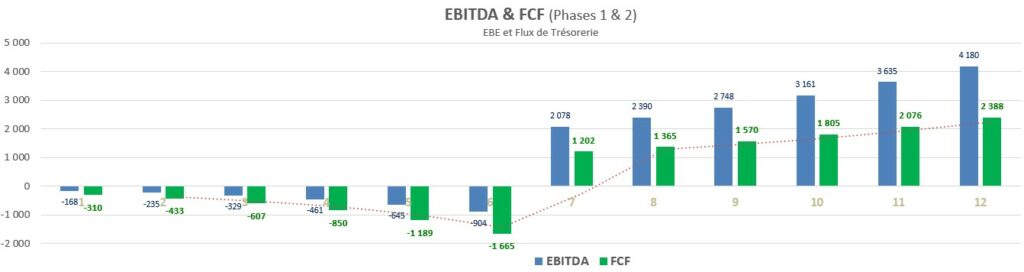
One indicator is essential in this model: Free Cash Flow (FCF). The chart below illustrates the metamorphosis of our initial startup, originally focused on aggressive growth, into a genuine “cash machine,” implying a radical change in mindset:
- During the six years of the “VC” phase, our startup burns through €5 million in cash, meaning that investor contributions must be supplemented by other funding sources, often public financing.
- The following six years, by contrast, generate more than €10 million in free cash flow, allowing the company to comfortably repay its senior debt.
At the end of the LBO period, if the transaction unfolds as planned, the company may even be sold back to management through a Management Buy-Out (MBO), enabling the Private Equity fund to exit with a multiple equal to or greater than that achieved by the VC investors during Phase 1.
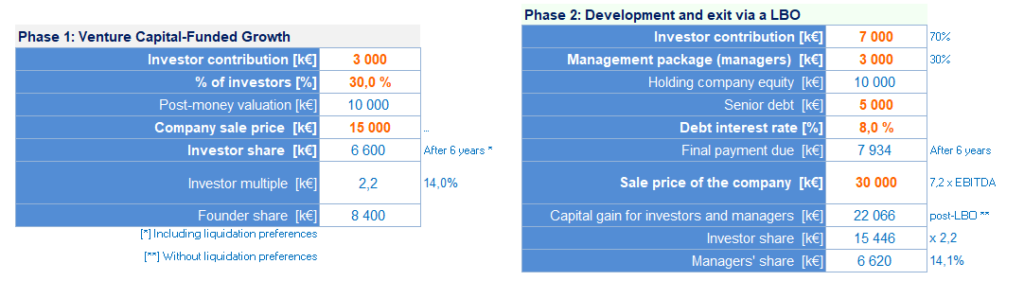
This model demonstrates that an LBO exit option represents the “king’s choice,” as illustrated by the exits of companies such as Big Mamma or Point Vision Group, which had exceeded €100 million in revenue and were valued at more than €200 million. However, such successes are exceptional, and smaller LBO transactions are more difficult to complete, especially for startups that have only recently crossed the profitability threshold. It should be remembered that fewer than 60% of venture capital-backed startups are profitable at the time of exit, and most are sold to large corporations for their technology and/or commercial potential. Nevertheless, the development of this type of financial exit represents an attractive prospect both for startup founders and for executives of traditional SMEs.
If this growth trajectory can apply to your company, cash management will become a determining component of your leadership approach, requiring you to revisit the fundamentals of your value proposition and business model.
In entrepreneurship, cash remains the ultimate judge. Transitioning from a VC phase to an LBO phase requires a radical cultural shift for management: the company is no longer managed around a “top line” growth trajectory (sales growth), but around “bottom-line” operational efficiency (EBITDA and working capital management) capable of servicing debt without hindering growth.