Version française/French version: LINK
The Eisenhower Matrix is a valuable tool for helping entrepreneurs balance urgency and importance amidst the multitude of daily demands. Artificial intelligence and “no-code” technologies enhance the matrix’s four quadrants by automating low-value tasks and facilitating both decision-making and strategic thinking. However, AI does not redefine our priorities; it acts as a co-pilot whose effectiveness relies on human judgment. AI enables entrepreneurs to better manage their time, a resource often even scarcer than their cash reserves.

The average European entrepreneur works 48 hours per week, 12 hours more than the average worker, who puts in 36 hours (sources: Eurofound and Eurostat). Yet only 2 to 7 hours per week, or 4% to 15% of working time, are devoted to strategic thinking and long-term projects. The rest is absorbed by day-to-day operations (production, delivery, problem-solving), team management, sales and customer relationships, as well as administration, finance, HR, and compliance.
Whether you are an entrepreneur or the President of the United States, managing your schedule is essential. This is where the Eisenhower Matrix becomes an invaluable tool for avoiding overwhelm in the face of constant daily demands, echoing the famous observation attributed to the 34th U.S. President: « What is important is seldom urgent, and what is urgent is seldom important. »
For entrepreneurs, priorities cannot be determined in haste either. By learning to distinguish the essential from the incidental, we regain control over our time. The Eisenhower Matrix is a simple yet powerful framework that helps separate urgency from importance, enabling us to devote our energy to the activities that truly matter.
A CEO of a mid-sized company once told me that he began each morning by deciding what he was not going to do, allowing him to focus on priority tasks and strategic initiatives. Even when supported by an experienced and complementary team, entrepreneurs must still choose their battles and preserve time to think about the future.
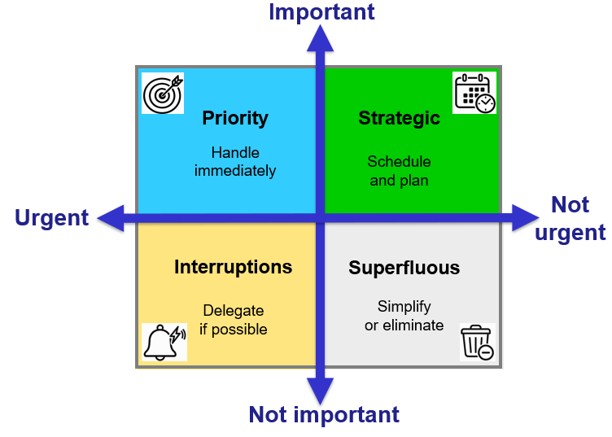
From an entrepreneur’s perspective, the potential impact of artificial intelligence and no-code technologies across the four quadrants of the Eisenhower Matrix can be summarized as follows.
Priority Tasks
These activities are both important and urgent, requiring immediate attention. AI and no-code tools enhance real-time decision-making. During a critical situation, a crisis, an urgent response to a strategic client, or a technical outage, generative AI can rapidly synthesize vast amounts of information, propose decision trees, and draft initial responses. On the no-code side, automated workflows ensure that critical alerts are routed instantly to the appropriate people, allowing entrepreneurs to focus on what matters most: making the final decision.
Strategic Initiatives
These are important but not urgent activities that build long-term value: business development, innovation, sustainability, cybersecurity, employee well-being, and other transformative projects. Because they lack immediate urgency, they are often postponed in favor of short-term demands.
This is also the quadrant where human judgment creates the greatest value. AI serves as a powerful catalyst for creativity and analytical thinking. It can identify market trends, evaluate competitors, and simulate complex financial scenarios. Meanwhile, no-code platforms dramatically lower the cost and speed of experimentation. Entrepreneurs can prototype an application or launch a new process within days, without relying on extensive technical resources.
Together, AI and “no-code” technologies give business leaders both the time and the tools to shape the future rather than merely react to the present.
Interruptions
These tasks are urgent but of limited importance. They demand attention without necessarily requiring the entrepreneur’s expertise. Many can be streamlined or delegated to preserve both time and mental energy. AI assistants and no-code automation are particularly effective in handling recurring requests. Appointment scheduling, lead qualification, email triage, and activity reporting no longer need to occupy the entrepreneur or even overload employees. By combining AI with no-code platforms, businesses can deploy intelligent conversational agents capable of answering common customer questions while automated workflows categorize and route incoming requests to the appropriate people.
The « Superfluous »
Activities that are neither urgent nor important create little value while consuming valuable attention. Identifying them makes it possible to reduce or eliminate them altogether, freeing both time and mental bandwidth. AI and no-code solutions can help identify these low-value activities, many of which persist simply out of habit. By analyzing calendars and workflows, AI can detect repetitive, time-consuming tasks that contribute little to business. Intelligent forms and automated processes can then reduce or eliminate these unnecessary activities, allowing entrepreneurs to focus on work with genuine strategic impact.
Greater Productivity or Greater Peace of Mind?
Has the Eisenhower Matrix been fundamentally transformed by AI and no-code technologies? Not really. Ultimately, defining what is urgent and what is truly important remains a human responsibility.
Technology enthusiasts argue that these tools act as copilots, helping us assess and optimize our actions along both dimensions of the matrix. At this point, however, the discussion becomes almost philosophical. Advocates of these « digital orthotics » see them as cognitive amplifiers, while more cautious observers warn against the limitations of these stochastic parrots, whose voracious appetite for data, energy, water, silicon, and other natural resources comes with significant costs. Errors, hallucinations, biases, and user overconfidence remain inherent risks.
There is little doubt that AI and no-code technologies can significantly improve productivity across all four quadrants of the Eisenhower Matrix. We are living through a profound transformation in our relationship with work. This represents genuine progress, provided we exercise discernment and preserve our capacity for independent judgment when making the decisions that matter most. Artificial intelligence does not replace the art of setting priorities. It simply gives entrepreneurs more powerful means to devote their time to what truly matters.