Version française/French version: LINK
The formulation of your strategy relies on a rigorous analysis of your business, your environment, and a clear articulation of both your objectives and those of your partners. Considering key issues such as the eventual exit of the founders is essential to securing your company’s long-term trajectory. This approach enables the development of a coherent growth plan, reflected in financial projections that are all the more credible when they are firmly grounded in operational reality.

…
To help a business creator or SME leader formulate their development strategy and translate it into financial flows, all it takes is a bit of method and a good deal of attentive listening. This helps clarify many issues, especially when the objectives of partners do not naturally align.
The purpose of this article is to provide a few guiding principles for supporting entrepreneurs operating across very different industries and regions. I will primarily adopt the perspective of a board member or strategic committee advisor with whom the executive (yourself) might share both personal dilemmas and the economic and financial information at hand.
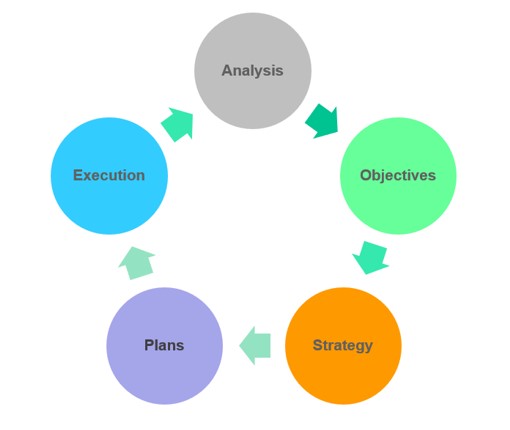
Strategic analysis and implementation approach
The analysis phase involves inviting the executive to carry out a diagnosis of their company and its environment. Simply taking a step back and analyzing available yet often underused information allows a return to fundamentals, particularly the value proposition. It is through this lens that you can segment your market and refine your competitive positioning, since you are not selling “to everyone,” nor are you in direct competition with all your peers.
This analytical phase results in a structured review built around five main components:
- History, needs addressed, offering, and business model.
- Target market segments and sales process.
- Key economic and financial data.
- Management, governance, and company culture.
- Main challenges facing both the company and its leader.
Following this diagnosis, clarifying objectives becomes a crucial step. When these objectives are clearly articulated and shared with your partners, formulating a development strategy becomes significantly easier. You can then work backward through a form of strategic and financial retro-planning, with the defined long-term objective serving as the endpoint.
The exit of founding partners: a key issue
The question of founders’ exit objectives is sometimes overlooked, even though it directly impacts both your pace of development and the profile required at the time of exit. This issue is not limited to venture-backed startups, where exit is a core component of the deal; it also applies to family businesses, where a founding leader may wish to step back from day-to-day operations without fully relinquishing control. Managing this transition carefully is a major challenge, both for “those who leave” and for “those who remain.”
When you have reliable information about your company and its environment, and your objectives are clearly defined, formulating and quantifying your development strategy becomes much easier. This strategy can then be described in a business plan, which should clearly outline the technical and commercial milestones required to achieve your medium- or long-term objectives, while remaining adaptable to changing conditions.
This inherently iterative process leads to a business plan whose main components can be summarized as follows:
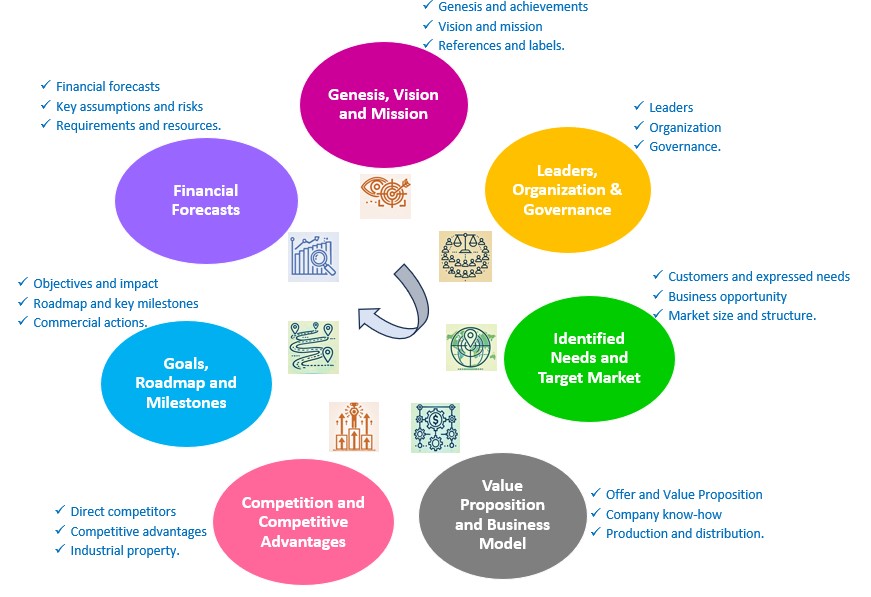
Business Plan Framework
Your financial projections will be all the more credible if they reflect a coherent development trajectory grounded in operational reality:
- Start from average or median transactions by segment, expressed through pricing and payment terms that will feed into your working capital requirements (WCR).
- Justify the cost of each transaction: raw materials, subcontracting, royalties, etc.
- Clearly present the number of monthly transactions and total annual sales, both from existing clients and new customer acquisition.
- Substantiate your technical, commercial, and administrative headcount, along with the associated payroll costs, based on past productivity and key industry ratios.
- Document your capital expenditures (Capex) and operating expenses (Opex) with particular attention to marketing and sales spending.
- Balance your financing plan using resources appropriate to your stage of development: equity, debt, grants, and subsidies.
The mirror of life choices
This process is enriched through dialogue with your partners and advisors. Such an approach is highly fruitful, as stepping back allows you to clarify your value proposition and “choose your battles.” In particular, it helps you avoid responding to opportunities that are incompatible with your margins or your values.
This brings us back to the title of this piece and to the virtues of strategic conversation applied to the formulation of your business plan, leading to financial modeling aligned with your aspirations. The foundation of this exchange is trust, which is essential for sharing key information about your goals, strengths, and vulnerabilities. Beyond their own entrepreneurial experience, your counterpart must demonstrate deep empathy, holding up a mirror to your life choices and the actions that stem from them.
Wishing you the very best in this strategic, financial, and introspective odyssey.